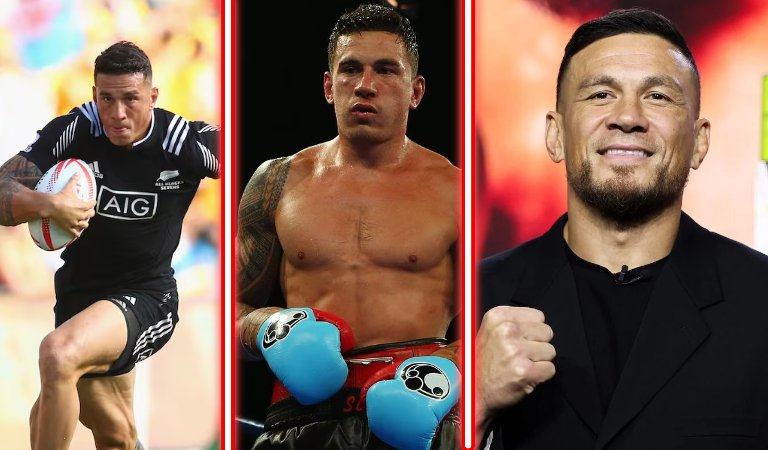
Sonny Bill Williams: The Explosive Rise, Painful Setbacks, and Enduring Greatness of a Cross-Code Champion
From teenage rugby prodigy to world champion and public figure, this is the verified story of talent, controversy, faith, resilience, and reinvention.

Introduction
Sonny Bill Williams is one of the rare modern athletes whose story feels bigger than a single sport. He made his name in rugby league, reached global status in rugby union, represented New Zealand on the Olympic stage, and then kept testing himself in professional boxing. That mix of skill, physical power, timing, and courage is why his career still stands apart from most stars of his era.
What makes his journey even more compelling is that it was never smooth from start to finish. Alongside medals, titles, and memorable performances, there were injuries, criticism, pressure, and public scrutiny. Yet he kept rebuilding, changing codes, and returning to elite competition, which is a major reason his biography continues to attract interest across rugby and boxing audiences.
Quick Bio
| Field | Details |
|---|---|
| Full name | Sonny William Williams |
| Date of birth | 3 August 1985 |
| Age | 40 |
| Birthplace | Auckland, New Zealand |
| Nationality | New Zealander |
| Height | 191 cm (6 ft 3 in) |
| Weight | 108 kg in rugby listings |
| Religion | Islam; All Blacks records describe him as the first Muslim All Black |
| Spouse | Alana Raffie |
| Children | Five |
| Education | Bachelor of Applied Management (Sport Management) with distinction, Otago Polytechnic |
| Main fields | Rugby league, rugby union, professional boxing, media/public work |
Early Life and Family Background
He was born in Auckland and grew up in Mount Albert in a working-class family. Public biographies identify his father as Ioane “John” Williams and his mother as Lee Woolsey, and note that he has an older brother, John Arthur, plus younger twin sisters, Niall and Denise. Those roots matter because they shaped the toughness, humility, and hunger that later became central to his public identity.
His early years were not built around comfort or celebrity. Reports on his upbringing describe a shy child with obvious athletic gifts, someone who could run, jump, and compete well above his age group. He attended Owairaka School, Wesley Intermediate, and Mount Albert Grammar School, and long before international fame, he was already known as a naturally gifted sportsman.
How the Career Began
Before he became a global name, he was a Marist Saints junior who caught the eye of Bulldogs scout John Ackland. That talent identification changed everything. He moved into the Canterbury-Bankstown system as a teenager and rose quickly through the junior ranks, showing the kind of size, balance, and offloading skill that made him different from the average young forward.
His official breakthrough came in 2004 with the Canterbury Bulldogs. NRL records show that he exploded into first grade in his debut season, scored on debut, became New Zealand’s youngest Test player after only a handful of top-level games, and ended that same season as an NRL premiership winner. Very few athletes begin that fast, and even fewer sustain the attention that follows such a start.
Breakthrough Years in Rugby League
The first phase of his career made him a headline figure in Australasia. He was not just a promising player; he looked like a future superstar. His mix of aggression, skill, and improvisation made him one of the most exciting players in rugby league, and his performances helped build the image of a once-in-a-generation talent.
That period was also the foundation of his public brand. Fans admired the athletic brilliance, while critics and rivals already understood how difficult he was to stop. By the time he was still in his early twenties, he had already won major honors and carried the pressure that comes with being marketed as one of the sport’s biggest names.
From Rugby League to Rugby Union
One of the boldest moves of his career came in 2008, when he left the Bulldogs and joined Toulon in France. The switch was controversial and heavily discussed, but it also opened the door to a second elite career. Instead of staying inside one system, he chose risk, change, and a much bigger challenge.
That decision changed how people viewed him. For some, it damaged his image in rugby league at the time. For others, it proved that he was willing to bet on himself at the highest level. Either way, the move to union did not end his career; it expanded it and eventually pushed him toward an even wider global audience.
All Blacks Peak and World Cup Success
After returning to New Zealand in 2010, he made his All Blacks debut against England and quickly became part of the national setup. Official All Blacks records credit him with 58 Tests, and he was part of the squads that won the Rugby World Cup in 2011 and again in 2015. That alone would be enough to define a major career, but for him it was only one chapter.
He also played for the Crusaders, Chiefs, Blues, and other union sides, and later represented New Zealand in rugby sevens at the Rio Olympics. His union years showed more than physical power. They showed timing, vision, soft hands, and one of the most recognizable offloading games in modern rugby. At his best, he was not simply effective; he was memorable.
Boxing, Injuries, and Resilience
Professional boxing became another serious test in his sporting life. BoxRec lists him as a heavyweight with 11 professional bouts and a record of 9 wins and 2 losses, with his career spanning from 2009 to 2025. That record matters because it confirms that boxing was not just a side hobby or a publicity act. It became a real competitive lane in his post-rugby identity.
The downside of such an intense career was the physical toll. Reuters reported that he suffered a partial Achilles rupture during the 2016 Rio Olympics, a cruel setback that ended his sevens campaign. Injuries later became a recurring theme around the later years of his rugby career, and that constant battle with the body is an important part of understanding both his decline and his resilience.
Later Fights and Competitive Edge
Even after retiring from rugby in 2021, he did not fully step away from the spotlight. NRL reporting said he would continue his professional boxing career, and he later returned to the ring for major bouts that kept his name in the public conversation. That willingness to keep competing, even after long success in two rugby codes, says a lot about his mentality.
One of the biggest recent moments came in July 2025, when Paul Gallen defeated him by split decision in Sydney. The result was a loss, but it also showed that his career story still had commercial power, emotional tension, and public relevance years after his rugby peak. Very few retired rugby stars can still command that level of attention in another combat sport.
Life Beyond the Field
His public story is not only about trophies and collisions. Faith has played a major role in how he presents himself and how many supporters understand his growth as a person. Official All Blacks material identifies him as the first Muslim All Black, and over time he has become known not just as an athlete, but also as a figure associated with discipline, family, and belief.
His life away from sport also includes education and business. He completed a Bachelor of Applied Management with distinction through Otago Polytechnic, which added another layer to his image, and his public channels now also connect to media work and his food brand, Sonny’s Eats, which launched in Sydney in 2026. That broader profile shows a man trying to build life beyond performance alone.
Legacy and Lasting Influence
The strongest part of his legacy is range. He won in rugby league, won at the highest level in rugby union, appeared at the Olympics, and built a legitimate boxing record. Official rugby sources describe him as a two-time Rugby World Cup winner, while boxing records confirm a long professional run in the heavyweight division. It is hard to find another modern athlete with that exact combination of achievements.
His influence also goes beyond titles. He changed how many fans think about crossover athletes, and he showed that reinvention is possible even under intense pressure. Some will remember the controversies and setbacks, while others will remember the brilliance, generosity, and courage to keep evolving. The truth is that his story includes both, and that is exactly why it still matters.
Conclusion
Sonny Bill Williams built a career that was exciting, unusual, and often unpredictable. He began as a teenage rugby league sensation, became an All Blacks world champion, tested himself in boxing, and stayed relevant long after many players from his generation had stepped away. His biography is powerful because it contains both triumph and turbulence without losing its sense of direction.
For readers searching for the real story behind the fame, the most important point is simple. He was never just a highlight reel athlete. He was a competitor who kept taking risks, a public figure who kept evolving, and a sportsman whose name remains tied to ambition, resilience, and big-stage performance across multiple arenas.
Read this too: Cynthia Ramirez and Kyle Eastwood 7 Powerful Facts About Their Inspiring Public Story
FAQ
Who is Sonny Bill Williams?
He is a New Zealand athlete best known for elite careers in rugby league, rugby union, and professional boxing. He also became a two-time Rugby World Cup winner with the All Blacks and later remained active in boxing and public media work.
When and where was Sonny Bill Williams born?
He was born on 3 August 1985 in Auckland, New Zealand.
What made him famous?
He became famous first for his explosive rise with the Canterbury Bulldogs in rugby league, then for winning at the highest level in rugby union with New Zealand, and later for continuing his sporting story in professional boxing.
How many Rugby World Cups did he win?
He won two Rugby World Cups with New Zealand, in 2011 and 2015.
Is he still boxing?
BoxRec lists him as an inactive heavyweight boxer, with his professional career running from 2009 to 2025.
Is Sonny Bill Williams married?
Yes. Public reporting identifies his wife as Alana Raffie, and they have five children.