Tony Parle: The Remarkable Rise, Harsh Setbacks, and Lasting Legacy of Australia’s Pickle Pioneer
A resilient story of family farming, commercial risk, national food supply success, and the hard lessons that shaped one of Australia’s best-known agribusiness journeys.

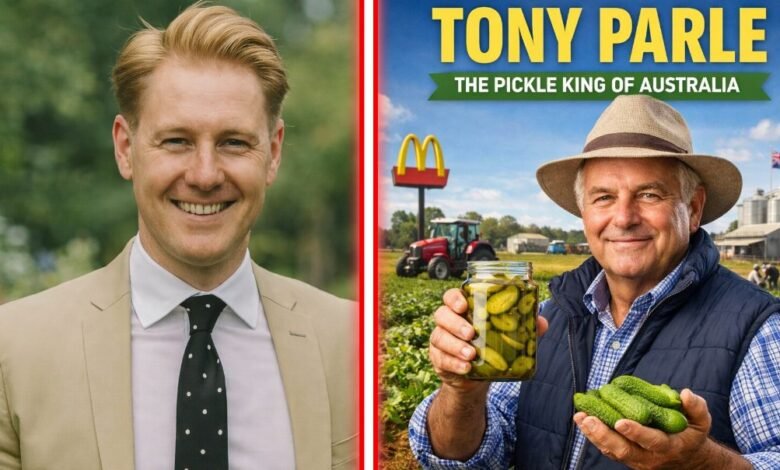
Table of Contents
ToggleIntroduction
Tony Parle is best known as the Australian agribusiness figure behind the pickle supply linked to McDonald’s Australia. While he is not a mainstream celebrity, his story stands out because it combines local farming roots, long-term business building, serious financial setbacks, and a comeback built on persistence rather than public attention.
What makes Tony Parle especially interesting is that his career grew from a highly specific niche. He did not become known for a broad corporate empire or a media-driven brand. Instead, he became associated with a product most people overlook on a burger: the pickle. That unusual path turned him into a memorable name in Australian food production and regional enterprise.
Early Life and Farming Roots of Tony Parle
Tony Parle came from a farming background in regional New South Wales, with strong ties to the Griffith and Riverina area. Public reporting describes the Parle family as rice and wheat growers before the business shifted into other crops and eventually into the pickle trade. That background matters because it explains why his later success was built on practical agricultural experience, not just theory or outside investment.
Life in a farming district also meant learning how to respond to pressure. Seasonal changes, water challenges, crop decisions, and market conditions were part of the environment that shaped his thinking. The move into gherkins was not a random step. It was a commercial decision made in a rural setting where survival often depends on choosing the right crop at the right time.
From Traditional Crops to a Niche Opportunity
Before the pickle business became famous, the family had experience with broader farming activity. Later profiles about the operation describe a business that tried different crops over the years, including corn and vegetables, before pickles became the defining product. That experimentation shows a willingness to adapt rather than stay fixed in one old model.
The gherkin opportunity arrived at a time when Australian agricultural businesses had to think carefully about scale, reliability, and customer demand. This was the setting in which Tony Parle began building the identity that would eventually make him one of the most recognizable names in this small but important part of food supply.
The Start of Tony Parle’s Career and the McDonald’s Breakthrough
The real turning point in the public career story came around 1990. Reporting on the McDonald’s supplier relationship says that Tony first secured one-third of Australian pickle orders, and within a month the contract expanded to cover all of the business. That shift was huge because it moved him from ordinary production into a national supply role with very high consistency demands.
From that point forward, Tony Parle was no longer simply a regional grower. He became part of a major fast-food supply chain, where quality, timing, and continuity mattered every week. The relationship became one of the defining features of his reputation, and later sources continued to identify the Parle family as the producer behind McDonald’s pickles in Australia.
Why This Opportunity Was So Important
Large food contracts reward reliability, but they also expose weakness very quickly. A supplier must manage farming, harvesting, processing, and delivery without major interruptions. In other words, the breakthrough created a major opportunity, but it also brought pressure that would test the business for years.
That is why the story of Tony Parle is more than a simple success story. It is also a story about whether a family-based agricultural operation can meet national commercial expectations over a long period. In his case, the answer was yes, but not without setbacks.
Tony Parle and the Making of a Specialist Agribusiness
As the business expanded, Parle Foods became one of the best-known company names connected with Tony’s work. ABC reporting described Parle Foods in Griffith as a food processor that was Australia’s largest pickle producer and corn processor. That made the company significant not only for one contract, but also for its broader role in regional food processing.
The operation was not just about growing cucumbers. It involved processing, packaging, and maintaining standards that matched a national customer. Later descriptions of the family business also highlight how the Parle operation handled the full pickle journey, from the paddock to fermentation and processing, giving it a stronger commercial position than a farm that only grows raw produce.
Scale, Process, and Practical Discipline
Profiles about the business explain that the Parle operation grew gherkins in summer, pickled them in brine, and processed them for food-service use. A later family profile also noted that the business remained relatively small in team size despite producing at a level that reached restaurants across Australia. That contrast between modest structure and large output is one reason the story attracts interest.
In simple terms, Tony Parle built a specialist agribusiness around one product category and did it well enough to stay relevant for decades. That is not glamorous on the surface, but in supply-chain terms it is a major achievement.
The Difficult Years: Debt, Drought, and Business Pressure
The career of Tony Parle also includes a severe downturn. ABC reported that Parle Foods was placed into receivership and carried debts of up to $45 million. For any business, that kind of pressure is devastating, and for a regional processing company it can threaten not only ownership but also local jobs and supplier confidence.
The pressure did not end there. Later reporting explained that after buying back the pickle operation and using it to restart through Australian Frozen Foods, the business was hit again when drought conditions destroyed crops because of water allocation issues. This is the negative side of the Tony Parle story, and it is an important reason the biography feels real rather than polished.
Recovery Through Persistence
Instead of disappearing after failure, he kept going. Reporting says he bought back the pickle operation and used it to kick-start a family-owned business called Australian Frozen Foods. That move matters because it shows that recovery was built from the most durable part of the original enterprise rather than from a complete reinvention.
This comeback phase is central to understanding Tony Parle. Many business profiles focus only on the peak. His story is stronger because it also includes collapse, uncertainty, and reconstruction. That mix of growth and difficulty gives the biography depth and makes it useful for readers interested in entrepreneurship, farming, and resilience.
How Tony Parle Built a Lasting Pickle Operation
Operational details from family and industry profiles show how carefully the business was designed. The Parle farm near Griffith has been described as a large property where irrigated land is used for pickle production, with harvesting across the summer season and on-site processing tied closely to customer needs.
One of the strongest ideas repeated in coverage is consistency. The family profile published by Australian Farmers says the Parle family has produced pickles for the fast-food chain for over three decades, while official McDonald’s Australia sourcing material still features Tony Parle as its pickle farmer. That long relationship says a lot about trust, standards, and performance.
The Value of Reliability
A burger customer may never think about the pickle supplier, but large restaurant systems do. They care about exact size, taste, timing, food safety, and uninterrupted delivery. The fact that the Parle business stayed part of that system for so long suggests that it met those expectations again and again.
That is why Tony Parle matters in a bigger business sense. He represents the kind of operator who turns a very small ingredient into a major logistical responsibility and then builds a reputation by delivering it consistently.
Why Tony Parle Matters in Australian Agribusiness
Tony Parle matters because he shows how regional agriculture can connect directly to national brand supply. His work was not built on fame, trend-driven marketing, or a personal media image. It was built on a product, a process, and a long commercial relationship that lasted through highs and lows.
He also matters because his story reflects the realities of Australian farming. There is opportunity, but there is also drought, debt, risk, and constant pressure to stay efficient. In that sense, his biography is not just about pickles. It is about endurance in business.
Complete Career Overview
The complete career overview of Tony Parle can be understood in clear stages. First came his early life in a family farming environment near Griffith. Then came the move into gherkins and the major contract breakthrough that placed him inside a national food-service chain. After that came business expansion through Parle Foods, followed by financial crisis, receivership, and drought-related hardship. Finally, there was a recovery phase built around Australian Frozen Foods and the continuation of the pickle supply legacy.
Seen as a whole, the career of Tony Parle is a strong case study in niche specialization. He built recognition in a very specific category, lost major ground during hard years, and still remained linked with one of the most durable supplier stories in Australian food production.
Conclusion
Tony Parle is not famous in the usual celebrity sense, but his biography is far more substantial than many public profiles. He built a name through farming skill, processing discipline, and long-term supply performance. He also faced the kind of setbacks that can destroy a business, yet his story remained one of recovery and relevance. That combination of success and struggle is exactly what makes his legacy memorable.
For readers, entrepreneurs, and business researchers, the life story of Tony Parle offers a clear lesson: even a product as small as a pickle can support a powerful career when it is backed by focus, resilience, and the ability to keep going after hard setbacks.
Read this too: Greg Sadlier: A Powerful Biography of Expertise, Vision, and the Quiet Discipline Behind the Modern Space Economy
FAQ
Who is Tony Parle?
Tony Parle is an Australian farmer and agribusiness entrepreneur best known for his long-running connection to the pickle supply for McDonald’s Australia.
What is Tony Parle known for?
He is known for building a specialist pickle and food-processing business and for becoming strongly associated with Australia’s McDonald’s pickle supply chain.
Where is Tony Parle based?
Public reporting links him to Griffith and the Riverina region of New South Wales, Australia.
Which companies are linked with Tony Parle?
The main business names publicly linked with him are Parle Foods and Australian Frozen Foods.
Why is Tony Parle called the Pickle King?
Media-style coverage has used labels such as “Pickle King” and “Gherkin King” because of his long-term work in pickle farming, processing, and supply.
Did Tony Parle face major business setbacks?
Yes. Public reports describe receivership, major debt pressure, and drought-related crop losses before the business recovered through a later phase.