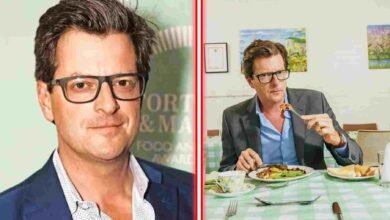


Peter O’Toole began life with a dispute that suited the rest of his career: nobody seemed able to place him neatly. He often said that he possessed two birth certificates, one Irish and one English, and remained uncertain about where he had been born. Official records locate his birth at St James’s University Hospital in Leeds on 2 August 1932. O’Toole nevertheless felt Irish. His father, Patrick Joseph “Spats” O’Toole, came from Ireland, and the actor later described Irishness as central to his understanding of himself.
His family followed a restless pattern during his early childhood. Spats worked as a metal plater, footballer and bookmaker, and the racing calendar drew the family through towns across northern England. O’Toole grew up around wagers, sudden reversals and men who could turn a story into a performance. His mother, Constance, had trained as a nurse and brought a different kind of discipline to the household. The combination of theatrical bravado and hard practicality would reappear throughout her son’s life.
Catholic schooling gave him little comfort. O’Toole attended St Joseph’s in Leeds and later recalled being frightened by the nuns and the severity of the institution. His comments were characteristically comic, but they concealed real hostility towards an education based on fear. Illness also interrupted his childhood. He spent long periods away from ordinary school life and developed the habit of reading intensely, a practice that stayed with him after the drinking stories had begun to obscure his intellectual interests.
Ireland offered him a sense of belonging. A youthful visit to County Kerry reportedly made him feel that his differences no longer marked him as an outsider. He later kept a home near Clifden in County Galway, held an Irish passport and spoke about Ireland through its literature, history and geography. Yet he had grown up in Leeds, acquired an English theatrical education and spent much of his working life in London. His identity was not a tidy choice between two countries; it was a productive argument between them.
That argument shaped his voice and presence. O’Toole could sound aristocratic, provincial, Irish and classically English within the same performance. He never appeared entirely at home in one category. The uncertainty surrounding his birthplace therefore matters for more than biographical trivia. It introduces a man who repeatedly made ambiguity useful, turning contradictions into part of his personal mythology.
The Reporter’s Notebook: The Career He Nearly Chose
O’Toole entered working life through journalism rather than theatre. As a teenager, he joined the Yorkshire Evening Post as a trainee reporter and photographer. He learnt to observe faces and listen for revealing phrases, but routine reporting frustrated him. His reportedly colourful prose offered an early warning of the actor and memoirist to come.
Theatre supplied the direction journalism lacked. O’Toole recalled hitchhiking to Stratford-upon-Avon and seeing Michael Redgrave play King Lear. The performance showed him that acting could contain language, danger and emotional scale at once. He did not move smoothly from that revelation to the stage. National Service intervened, and he spent two years as a signaller in the Royal Navy. An officer reportedly asked what he truly wanted to do. O’Toole answered that he wanted to become either a poet or an actor.
His first serious attempt met a revealing obstacle. Dublin’s Abbey Theatre school rejected him, reportedly because he could not speak Irish. The decision must have stung a young man who identified so strongly with Ireland. London offered another route. O’Toole won a scholarship to the Royal Academy of Dramatic Art and studied there from 1952 to 1954 alongside Albert Finney, Alan Bates and Brian Bedford. He later called theirs an exceptional class, although the school did not initially treat them as future stars.
RADA gave O’Toole technique but did not tame him. He disliked rigid instruction and resisted any approach that reduced acting to obedient reproduction. His generation became associated with social realism, yet O’Toole retained an attraction to rhetoric, gesture and heightened language. That choice sometimes produced thrilling performances and sometimes tipped into excess.
The Bristol Old Vic became his true apprenticeship. Between 1956 and 1958, he played dozens of parts, moving rapidly through Shakespeare, Shaw, Beckett, comedy and pantomime. He appeared as Hamlet, Jimmy Porter, Vladimir in Waiting for Godot and characters much older than himself. Repertory theatre demanded speed: an actor might rehearse one production during the day and perform another at night. O’Toole learnt stamina, vocal control and the practical craft of holding attention without a camera.
Critics and directors soon travelled to Bristol to see him. His Hamlet drew particular notice, while his performances displayed the qualities that later defined his screen work: unusual stillness followed by sudden violence, musical speech and a face that could switch from beauty to menace. By the time cinema discovered him, he had already tested himself across more roles than many film stars attempt in a lifetime. Lawrence did not create his talent. It enlarged an actor forged in crowded rehearsal rooms and provincial theatres.
The Desert Sword: Fame, Pain and Chaos on Lawrence of Arabia
David Lean’s Lawrence of Arabia turned O’Toole from a respected stage actor into one of the most recognisable men in world cinema. He was not the obvious choice. Albert Finney underwent an extensive screen test but declined the contractual commitment, while other established actors had also been considered. O’Toole had limited film experience, immense confidence and a face the camera found difficult to ignore. Producer Sam Spiegel worried about entrusting a vast production to him, but Lean saw the combination of intelligence, vanity and danger that the role required.
The physical casting was boldly inaccurate. T. E. Lawrence stood about five feet five inches tall, while O’Toole rose well above six feet. The difference changed the character’s effect. O’Toole’s Lawrence appears almost spectral in white robes, towering over groups yet emotionally separated from them. His bright eyes and sharp features made him seem both heroic and unstable. Rather than imitate the historical figure closely, he built a cinematic Lawrence whose fascination with his own image gradually became destructive.
The desert shoot punished everyone involved. Production moved through Jordan, Morocco and Spain, with cast and crew working in heat, dust and enormous open spaces. O’Toole initially found camels nearly impossible to ride. Their movement left him bruised and sore, especially during the long shots that required riders to travel great distances. He later told the story of buying sponge rubber in Beirut and placing it on his saddle. Bedouin companions then nicknamed him “Father of the Sponge”, while O’Toole joked that he had introduced sponge rubber to Arabian culture.
O’Toole embellished his memories with relish. He described crossing the desert with a transistor radio, cigarettes and a small bottle stored in the saddlebag. Such stories helped establish the legend of a man who treated danger as material for comedy. They should not hide the concentration visible on screen. Lean demanded precision, repeated takes and control over minute physical details. O’Toole had to sustain a psychologically complex performance while managing unfamiliar animals, restrictive clothing and a production whose scale could overwhelm any individual actor.
His friendship with Omar Sharif added warmth to the ordeal. Sharif played Sherif Ali, whose entrance through a desert mirage remains one of cinema’s most famous introductions. They shared late nights, jokes and the strange experience of becoming international stars through the same film. Their ease off camera strengthened a relationship on screen that moves from suspicion to loyalty, disappointment and grief.
The performance avoids a simple heroic ascent. O’Toole presents Lawrence as witty and audacious, but also exposes vanity, cruelty and an appetite for adoration. After a dangerous desert crossing, confidence hardens into belief in his exceptional nature. Later violence breaks that fantasy without restoring innocence. His face registers exhilaration and disgust almost simultaneously.
One episode illustrates his ability to make discomfort dramatically useful. Lawrence’s torture at Deraa remains partly obscured, both historically and within the film. O’Toole plays the aftermath through damaged pride and bodily unease rather than a long explanation. His earlier elegance becomes fragile. The change makes later scenes more troubling because Lawrence can no longer maintain the identity he designed for himself. That psychological fracture gives the epic an intimate centre.
Publicity concentrated on O’Toole’s beauty, blue eyes and rebellious behaviour. The image proved powerful, yet it also trapped him. Audiences expected later roles to reproduce Lawrence’s scale, while he wanted grotesque comedy and modern despair. He rejected the cautious career management that might have protected his reputation.
Lawrence of Arabia received ten Academy Award nominations and won seven, including Best Picture and Best Director. O’Toole received his first Best Actor nomination but lost to Gregory Peck for To Kill a Mockingbird. The result began a record that would follow him for more than forty years. Hollywood honoured the film that made him famous while repeatedly withholding its competitive acting prize from the man at its centre.
The Cardboard Crown: Kings, Risks and Magnificent Failures
O’Toole answered Lawrence by playing power in several different keys. In Becket, released in 1964, he portrayed Henry II opposite Richard Burton’s Thomas Becket. Burton brought sombre resistance, while O’Toole made the king needy, furious and emotionally exposed. Their conflict worked because it was also a damaged love story between men separated by office, faith and pride. Both actors received Oscar nominations, and neither won.
Henry II returned four years later in The Lion in Winter. O’Toole became one of the rare actors nominated twice for playing the same historical character in different films. His second Henry was older, though the actor himself was only 36, and locked in a savage family contest with Eleanor of Aquitaine. Katharine Hepburn met his aggression without yielding an inch. Their exchanges sound like marital warfare conducted by two people who remain fascinated with each other.
The Ruling Class gave O’Toole one of his strangest leading roles as Jack Gurney, an aristocrat who believes he is Jesus Christ and later adopts a far darker identity. The film mixes satire, musical interludes and violence while attacking the English class system. O’Toole’s performance moves from expansive benevolence to cold authority. Its risks divided viewers, but the Academy gave him another nomination.
Failure attracted him almost as strongly as prestige. Man of La Mancha asked him to play Miguel de Cervantes and Don Quixote, although his singing voice did not suit every demand of the musical. The production suffered from creative compromises, and critics responded harshly. O’Toole never built a career around avoiding embarrassment. He pursued grand material even when the result could collapse publicly, a habit that produced both distinctive work and costly mistakes.
His 1980 Macbeth at the Old Vic became a notorious theatrical disaster. Reviewers attacked it, yet audiences arrived in growing numbers. He challenged the public to decide whether it was watching bravery, self-destruction or both.
Smaller projects revealed more control. Rogue Male cast him as a hunter pursued after attempting to assassinate a European dictator. In The Stunt Man, he turns charm into a weapon as a film director who may be murderous or merely committed to his picture. My Favorite Year let him parody his legend through an ageing screen adventurer terrified of live television.
O’Toole also returned repeatedly to the stage. He played Uncle Vanya, revisited Shaw’s Man and Superman and found a late theatrical triumph in Jeffrey Bernard Is Unwell. The play places its drunken columnist inside a locked Soho pub, surrounded by memories, restaurant chairs and the debris of a life turned into anecdotes. O’Toole understood the character’s charm and waste from close range, but he played him with restraint rather than imitation.
His uneven choices make the career more interesting. O’Toole could move from a superb performance to a production beneath his abilities, then return with his authority intact. He treated acting as a hazardous practice rather than a sequence of carefully branded successes. His attention remained fixed on the moment before the crown fell.
The Hospital Bracelet: The Cost Behind the Drinking Stories
O’Toole’s drinking became inseparable from his public identity. Stories placed him beside Richard Harris, Richard Burton and Peter Finch in bars, parties and escapades whose details grew with every retelling. O’Toole encouraged the mythology because he understood the value of a strong anecdote. Interviewers received polished tales delivered in a musical voice, and newspapers gained a character more vivid than the ordinary business of rehearsal.
The legend carried real damage. His marriage to Welsh actress Siân Phillips, with whom he had daughters Kate and Patricia, deteriorated amid jealousy, absence and alcohol. Phillips later described the cruelty and instability she experienced. Treating the period only as glamorous misbehaviour erases the effects on those closest to him. O’Toole’s charm did not cancel the fear, anger or exhaustion created by his conduct.
Heavy drinking also simplified how people judged his work. The public image suggested an actor relying on instinct and intoxicated daring, yet colleagues saw a trained performer with an exceptional command of language. He could memorise demanding verse, adjust rhythm precisely and use apparent spontaneity to conceal preparation. His appetite for risk was genuine, but it rested on years of repertory discipline. The wild man and the craftsman occupied the same body.
That body failed dramatically during the 1970s. Severe pancreatitis led to major surgery in which doctors removed much of his pancreas and part of his stomach. The consequences included insulin-dependent diabetes and an altered relationship with food and alcohol. Further illness brought him close to death. Reports often framed the crisis as the inevitable bill for years of excess, but O’Toole rejected simple medical and moral explanations.
Recovery forced practical changes without turning him into a conventional figure of reform. He stopped drinking heavily, monitored his health and returned to demanding work. Rogue Male demonstrated his renewed concentration, while The Stunt Man restored his position in American cinema. His thinness and lined face now carried history that make-up could not reproduce. Age did not merely diminish the beauty seen in Lawrence; it gave his presence a sharper emotional cost.
The health crisis changed his acting rhythm as well. Earlier performances often surged towards display, whereas later work could draw power from fatigue, silence and embarrassment. O’Toole did not abandon theatricality, but he learnt to place it beside visible frailty. That tension became essential to his final major roles. Viewers knew the stories of survival, and he used that knowledge without asking for pity.
O’Toole remained wary of turning his life into a lesson. He had helped create the legend, benefited from it and suffered beneath it. His survival was not proof that excess carried no price. Nor did illness transform every reckless choice into romantic folklore. The hospital bracelet belongs beside the desert sword because both reveal endurance, but only one records what endurance demanded.
The Unwanted Oscar: Eight Defeats and a Final Reinvention
O’Toole’s relationship with the Academy Awards became a long-running comedy with a serious undertone. He received eight competitive Best Actor nominations and won none. The nominated roles covered four decades: Lawrence, Henry II twice, Arthur Chipping, Jack Gurney, Eli Cross, Alan Swann and Maurice in Venus.
The Academy offered him an Honorary Oscar in 2002, to be presented at the 2003 ceremony. O’Toole initially resisted. He wrote that he remained “in the game” and wanted a chance to win the award outright. The reply contained pride, humour and a reasonable artistic objection: a lifetime award can sound like an instruction to leave. His children persuaded him to accept, and Meryl Streep presented the statuette.
His acceptance speech balanced gratitude with performance. O’Toole sounded delighted by cinema rather than embittered by defeat. The award did not finish his career. Venus gave him his eighth competitive nomination. He played Maurice, an elderly actor whose attraction to a younger woman exposes vanity, tenderness and approaching death. He let desire remain awkward, selfish and human.
Late roles introduced him to audiences who had never seen Lawrence in a cinema. He played King Priam in Troy, appeared in Stardust and voiced Anton Ego in Ratatouille. O’Toole made the severe critic physically present through clipped phrasing and controlled contempt. Ego’s response to a simple dish returns him suddenly to childhood, without sentimentality.
Literature remained the quieter thread connecting every phase. O’Toole said he knew all 154 Shakespeare sonnets and read them continually. He also published two volumes of memoir under the title Loitering with Intent. The books cover childhood and apprenticeship rather than his most famous years. Their selective structure suggests that he preferred origins, language and atmosphere to a straightforward catalogue of celebrity scandals.
Retirement finally arrived in 2012, when O’Toole announced that acting no longer brought him the same feeling. He died on 14 December 2013, aged 81. Tributes naturally returned to the white robes, blue eyes and desert horizons of Lawrence of Arabia. That image remains irresistible, but it represents only one victory in a career built from risk, technical training, failed experiments and repeated recoveries.
The competitive Oscar he never won has become an easy summary, though it tells little about the work itself. Awards count outcomes; acting survives through moments. O’Toole left Lawrence extinguishing a match with his fingers, Henry II roaring through family warfare, Eli Cross observing chaos from above and Anton Ego falling silent over a taste from childhood. Those scenes reveal the more useful record: an actor who could make intelligence visible and danger attractive.
Peter O’Toole turned himself into a public myth, then spent decades testing its limits. He could be disciplined and destructive, generous and cruel, precise and excessive. His lesser-known story is not that the legend was false. It is that the legend covered a more demanding achievement: beneath the anecdotes stood a reader, write
READ ALSO: Levapioli: A Flavorful Balkan Grilled Delight You Need to Try