

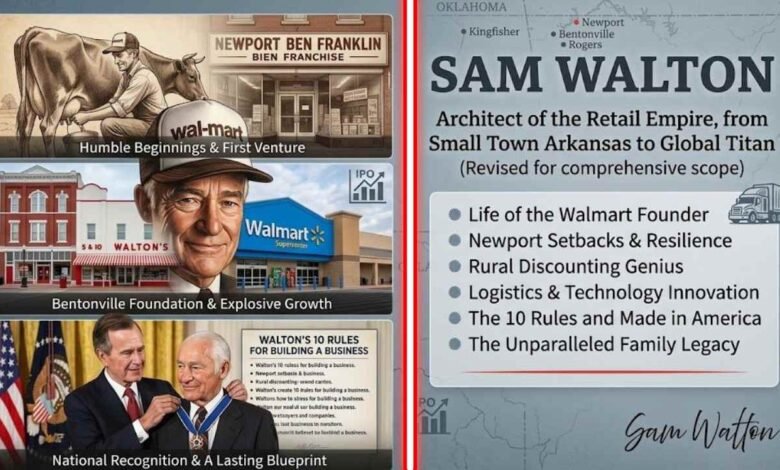
When you think of modern retail, one name stands above the rest: Sam Walton. As the founder of Walmart and Sam’s Club, he completely revolutionized the way the world shops. By prioritizing low prices, high volume, and rural markets, he transformed a single variety store in Arkansas into the largest corporation in the world by revenue.
But who was the man behind the blue vests and falling prices?
His story is not just a tale of massive wealth; it is a masterclass in supply chain logistics, customer psychology, and relentless determination. From milking cows during the Great Depression to receiving the Presidential Medal of Freedom, his journey reshaped global commerce.
In this article, we will explore the early life of Sam Walton, the setbacks that almost ruined his career, the strategies that fueled Walmart’s explosive growth, and the lasting financial legacy of his family.
The Early Life of Sam Walton
Born on March 29, 1918, in Kingfisher, Oklahoma, Sam Walton grew up during the devastating economic hardships of the Great Depression. His father, Thomas, was a farmer who transitioned into mortgage banking to survive, and his mother, Nan, ran a small milk business to help the family make ends meet.
Young Sam learned the value of a dollar early on. Before he was ten years old, he was already milking the family cows, bottling the milk, and delivering it to neighbors. By the seventh grade, he had expanded his efforts by selling magazine subscriptions and managing a lucrative daily newspaper route.
These childhood experiences instilled a deep work ethic that defined Sam Walton’s career. Hard work was not just an expectation; it was a matter of survival.
In high school, he excelled in both academics and athletics. He became the youngest Eagle Scout in Missouri state history at the time and quarterbacked his high school football team to a state championship. After graduation, he attended the University of Missouri (Mizzou), where he studied economics and worked odd jobs—including waiting tables—to pay for his education.
In 1940, just three days after graduating from college, he took a job as a management trainee at J.C. Penney in Des Moines, Iowa. Earning just $75 a month, he began his lifelong obsession with the retail industry. However, his career was briefly interrupted by World War II. He served in the U.S. Army Intelligence Corps from 1942 to 1945. During this time, he met and married Helen Robson, who would become his lifelong partner in both life and business.
The First Taste of Retail: The Newport Setback
When the war ended in 1945, the young veteran was ready to strike out on his own. With $5,000 in personal savings and a $20,000 loan from his father-in-law, he purchased a Ben Franklin variety store franchise in Newport, Arkansas.
This was his testing ground. He immediately began experimenting with concepts that were highly unusual for the era. Instead of relying entirely on the franchise’s approved corporate suppliers, he actively sought out cheaper, direct manufacturers so he could pass the savings onto his customers. He also embraced the relatively new concept of “self-service,” arranging wide aisles and allowing customers to pick items off the shelves themselves rather than waiting for a clerk to fetch them.
The strategy worked perfectly. In just five years, the Newport store became the most profitable Ben Franklin franchise in the entire region, with sales ballooning from $72,000 to $250,000.
But success brought an unexpected disaster.
His landlord, noticing the store’s massive financial success, refused to renew the lease. Because the original contract lacked a standard renewal clause, the young entrepreneur was forced out, eventually having to sell his highly profitable business and hand it over to the landlord’s family.
It was a crushing blow, but it taught him a vital, permanent lesson in real estate and contract law. He vowed never to let someone else control his destiny again.
The Birth of Walmart: How Sam Walton Changed Retail
Refusing to give up, Sam Walton moved his family to Bentonville, Arkansas, in 1950. There, he opened his own independent store, “Walton’s 5 & 10.” Today, this original storefront on the town square serves as the official Walmart Museum.
Throughout the 1950s, he successfully expanded his chain of variety stores across Arkansas and Missouri. However, by observing the market, he realized that the traditional “five and dime” variety store model was dying. The future belonged to large-scale, high-volume discount retailers.
In 1962, at the age of 44, he opened the very first Wal-Mart Discount City in Rogers, Arkansas.
Most retail experts at the time thought his business model was doomed to fail. Large competitors like Kmart and Sears focused exclusively on large metropolitan areas. The industry consensus believed that small, rural towns simply could not generate enough foot traffic or sales volume to support massive discount stores.
He proved them wrong. By targeting towns with populations under 10,000, Walmart operated without any serious corporate competition for decades.
Traditional Retail vs. The Walmart Approach
| Feature | Traditional Retailers (1960s) | The Walton Strategy |
| Location | Large cities and dense urban centers | Small rural towns and ignored suburbs |
| Pricing | High profit margins on fewer overall sales | Deep discounts driving massive daily volume |
| Distribution | Relied heavily on slow, external wholesalers | Built in-house, highly efficient regional distribution centers |
| Store Layout | Clerk-assisted shopping behind glass counters | Wide aisles with open self-service checkout |
By cutting out the middlemen and building a highly efficient regional distribution network, Walmart could restock its shelves faster and cheaper than anyone else in the industry. This structural advantage allowed the company to keep prices permanently low, attracting intensely loyal customers who no longer had to drive into the city to buy affordable goods.
Scaling the Empire and Embracing Technology
By 1970, Walmart had grown to 38 stores with over $44 million in sales. That same year, the company went public, trading its stock on the New York Stock Exchange. The vast capital raised from the initial public offering funded a massive, aggressive nationwide expansion.
Unlike many corporate executives of his era, Sam Walton was obsessed with technology. He understood that managing thousands of stores, millions of products, and tens of thousands of employees required flawless logistics. Under his direct leadership, Walmart became one of the first major retailers in the world to fully implement universal barcodes (UPCs) and computerized inventory scanning systems.
In the 1980s, the company launched its own private satellite network—the largest private corporate satellite system in the United States at the time. This massive technological leap allowed the corporate headquarters in Bentonville to track live inventory, process rapid credit card transactions, and communicate directly with store managers via voice and video in real time.
In 1983, looking for new avenues of growth, he launched Sam’s Club, a wholesale warehouse club designed for small businesses and bulk shoppers. In 1988, he introduced the first Walmart Supercenter, combining a massive grocery store with general merchandise under one roof, effectively changing the way modern Americans bought their food.
10 Rules for Building a Business
In his best-selling autobiography, Made in America, Sam Walton shared his famous 10 rules for business success. These principles remain a cornerstone of corporate leadership and management training today.
-
Commit to your business: Believe in your vision more than anyone else. Passion is contagious.
-
Share your profits with all your associates: Treat your employees as true partners, and they will treat you as a partner in return.
-
Motivate your partners: Money and ownership alone aren’t enough. Set high goals, encourage friendly competition, and keep things interesting.
-
Communicate everything: The more your team knows, the more they will understand and care about the success of the company.
-
Appreciate everything your associates do: A simple, sincere word of praise costs nothing but is worth a fortune in loyalty.
-
Celebrate your successes: Find humor in your failures. Don’t take yourself too seriously, and make work fun.
-
Listen to everyone in your company: The frontline workers who talk to your customers are the only ones who truly know what is going on.
-
Exceed your customers’ expectations: Give them exactly what they want and a little more. Stand behind everything you sell and apologize for mistakes.
-
Control your expenses better than your competition: This is where you can always find a competitive advantage, regardless of your company’s size.
-
Swim upstream: Ignore conventional wisdom. If everyone else is doing things one way, there is a good chance you can find a massive niche by going the opposite direction.
The Legacy and Family Net Worth
In March 1992, President George H.W. Bush presented Sam Walton with the Presidential Medal of Freedom, the highest civilian honor in the United States. During the ceremony, the President praised him as an American original who embodied the pure entrepreneurial spirit.
Just a few weeks later, on April 5, 1992, he passed away from bone cancer at the age of 74.
At the time of his death, he had grown his single Arkansas variety store into a staggering network of nearly 2,000 locations employing over 380,000 people. Today, Walmart is the world’s largest company by revenue, employing over 2 million people worldwide.
His financial legacy is equally monumental. The Walton family remains one of the wealthiest families in the history of the world. His children (Rob, John, Jim, and Alice) inherited substantial stakes in the retail empire. Because the family owns roughly half of all Walmart stock, their collective net worth regularly exceeds $200 billion, fluctuating with the stock market.
Despite building unparalleled wealth, the founder remained remarkably grounded throughout his life. He famously drove an old Ford pickup truck with his hunting dogs in the back, lived in the same modest house in Bentonville for decades, and preferred getting a cheap haircut at the local town barbershop.
Ultimately, Sam Walton proved that a simple, unwavering idea—giving working-class people everyday goods at the lowest possible prices—could change the world.
Read this too: Jaguar Land Rover Jobs: Careers, Salaries, Locations & How to Apply (2026 Guide)
FAQ
Where was the very first Walmart opened?
The first official Wal-Mart Discount City opened in Rogers, Arkansas, in 1962. Prior to that, the founder operated a Ben Franklin franchise in Newport, Arkansas, and Walton’s 5 & 10 in Bentonville.
How did the founder of Walmart die?
He passed away on April 5, 1992, at the age of 74, after a battle with multiple myeloma, a type of bone cancer.
What was the net worth of Sam Walton when he died?
At the time of his death in 1992, his net worth was estimated to be around $8 billion. However, he had already transferred the vast majority of his ownership stake to his wife and four children to avoid estate taxes.
Did the founder of Walmart write a book?
Yes. Shortly before his death, he co-authored an autobiography with John Huey titled Sam Walton: Made in America. The book details his life story, his overarching business philosophy, and the complete history of the company.
Why did Walmart initially focus on small rural towns?
In the 1960s, large discount retailers believed small towns couldn’t generate enough profit. Walmart deliberately targeted these overlooked rural markets, which allowed them to establish a fiercely loyal customer base and grow rapidly without facing direct competition from massive retail giants like Sears or Kmart.