
Copper Mining: A Complete Guide to History, Methods, and Modern Importance

Introduction
Copper Mining has played a vital role in human progress for thousands of years. From ancient civilizations crafting simple tools to modern industries building advanced technology, copper remains one of the world’s most valuable natural resources. Its excellent conductivity, durability, and recyclability make it an essential metal for construction, transportation, electronics, and renewable energy.
Today, Copper Mining continues to evolve with improved extraction methods, stronger environmental practices, and innovative technologies. As global demand for sustainable infrastructure grows, understanding how copper is mined and why it remains important has never been more relevant.
The History of Copper Mining
Early Civilizations and Copper Use
The story of Copper Mining dates back thousands of years. Ancient communities discovered that copper could be shaped into tools, ornaments, and household items because of its natural softness and durability.
As societies advanced, Copper Mining became more organized, allowing civilizations to develop stronger economies and better trade networks. Copper soon became one of the first widely used industrial metals.
Growth During Industrial Development
Industrial growth dramatically increased the demand for copper. Expanding cities required electrical wiring, plumbing systems, and transportation infrastructure. As a result, Copper Mining expanded into larger operations supported by improved machinery and exploration techniques.
Modern mining methods now allow producers to recover copper more efficiently while maintaining higher safety standards.
How Copper Mining Works
Exploration and Resource Evaluation
Every Copper Mining project begins with geological exploration. Specialists study rock formations, conduct surveys, and collect samples to determine whether sufficient copper deposits exist beneath the surface.
Accurate exploration reduces uncertainty and helps guide future mining activities.
Extraction Techniques
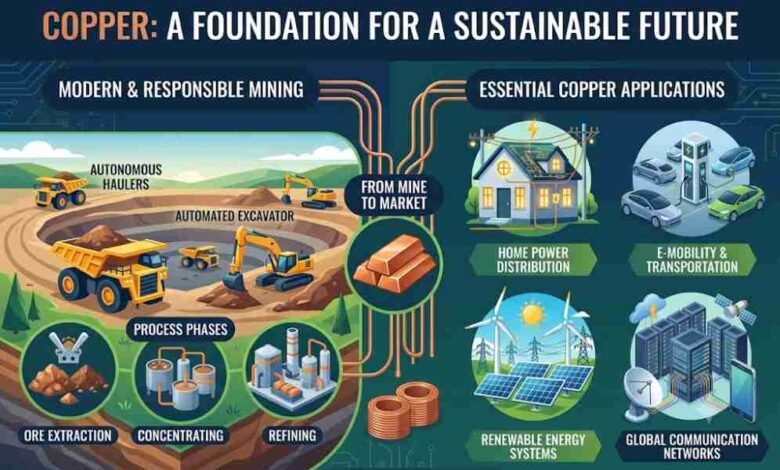
Several methods are used in Copper Mining, depending on the location and depth of the deposit.
Surface Mining
Surface mining removes rock layers covering shallow copper deposits. Large equipment transports ore for further processing while minimizing unnecessary excavation.
Underground Mining
When deposits lie deeper underground, underground mining creates tunnels that safely access valuable ore while reducing surface disturbance.
Both techniques play an important role in modern Copper Mining, with the selected method depending on geological conditions.
Processing the Ore
After extraction, the ore undergoes crushing, grinding, and concentration processes to separate valuable minerals from surrounding rock.
Additional refining produces high-purity copper suitable for manufacturing, electrical systems, construction materials, and industrial applications.
Why Copper Mining Matters
Supporting Modern Infrastructure
Nearly every modern economy depends on Copper Mining. Copper is widely used in electrical grids, communication networks, renewable energy systems, plumbing, transportation, and industrial equipment.
Without reliable copper production, many essential technologies would be difficult to manufacture or maintain.
Driving Economic Activity
Copper Mining contributes to employment opportunities across exploration, engineering, construction, transportation, equipment maintenance, environmental management, and research.
The industry also encourages investment in infrastructure and supports local economies through long-term development projects.
Environmental Considerations
Responsible Resource Development
Modern Copper Mining places greater emphasis on responsible environmental management. Mining operations increasingly focus on reducing emissions, conserving water, minimizing waste, and protecting surrounding ecosystems.
Careful planning helps balance resource development with environmental stewardship.
Land Rehabilitation
Once mining activities conclude, restoration efforts help return affected areas to productive use. Rehabilitation may include reshaping landforms, planting native vegetation, improving soil quality, and monitoring ecosystems over time.
These initiatives demonstrate how Copper Mining continues to adopt more sustainable practices.
The Future of Copper Mining
Growing Global Demand
Demand for copper continues to increase as countries expand renewable energy systems, electric transportation, modern communication networks, and advanced manufacturing.
Because copper is highly recyclable while maintaining its quality, Copper Mining works alongside recycling efforts to meet future material requirements.
Technological Innovation
Automation, artificial intelligence, digital mapping, and remote monitoring are transforming Copper Mining operations. These technologies improve worker safety, increase efficiency, and optimize resource recovery while reducing environmental impacts.
Innovation will continue shaping the future of the mining industry.
Conclusion
Copper Mining remains one of the world’s most important industries because it supplies a metal essential to everyday life. From powering homes and transportation systems to supporting renewable energy and communication technologies, copper continues to drive economic growth and technological progress.
As extraction methods become more efficient and environmental practices continue improving, Copper Mining will remain a cornerstone of sustainable development. Understanding its history, processes, and future potential highlights why this industry continues to play such a significant role in building the modern world.
Read this too: Jessica Stellina Morrison: The Untold Truth of the Powerful Force Behind Gino D’Acampo’s Empire