
Yayoi Kusama (1929–2026): An Emotional Farewell to the Queen of Polka Dots
From endless dots and mirrored rooms to a global cultural phenomenon, her art transformed how people experience contemporary art.

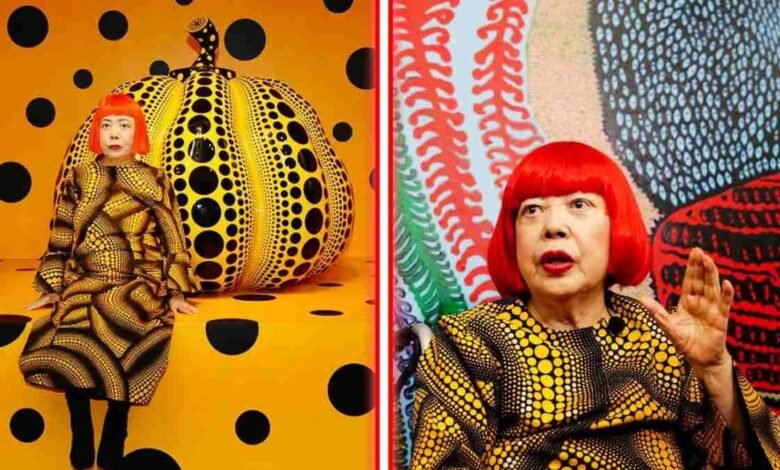
yayoi kusama was one of the most recognizable and influential Japanese artists of the modern era. Her work crossed painting, sculpture, installation, performance, film, literature, fashion, and design, creating a visual language built around repetition, infinity, mirrors, dots, nets, pumpkins, and vivid color. Major museums around the world have presented her work, while her immersive installations introduced contemporary art to audiences far beyond traditional galleries.
Her story was also one of extraordinary persistence. Born in Matsumoto, Japan, in 1929, Kusama began making art during childhood and later moved to New York, where she became part of the avant-garde scene. She eventually returned to Japan and continued producing art for decades. On August 14, 2026, Kusama died at a hospital in Tokyo at the age of 97, according to the Yayoi Kusama Museum and her official website.
Quick Bio
| Field | Confirmed Information |
|---|---|
| Full Name | Yayoi Kusama |
| Born | March 22, 1929 |
| Birthplace | Matsumoto City, Nagano Prefecture, Japan |
| Nationality | Japanese |
| Profession | Artist and novelist |
| Known For | Polka dots, Infinity Mirror Rooms, Infinity Nets, pumpkins, installations |
| Education | Kyoto Municipal School of Arts and Crafts |
| Major Artistic Fields | Painting, sculpture, installation, performance, film, literature, fashion |
| Moved to New York | 1957 |
| Returned to Japan | 1973 |
| Yayoi Kusama Museum | Opened in Tokyo in 2017 |
| Major Honor | Japan’s Order of Culture, 2016 |
| Died | August 14, 2026, aged 97 |
Early Life and Education
Yayoi Kusama was born in 1929 in Matsumoto City, Nagano Prefecture, and began drawing and painting from an early age. Her official museum biography states that she experienced visual and auditory hallucinations when she was young and started creating images based on nets and polka-dot patterns. Those recurring visual ideas later became central to her artistic identity.
In 1948, she went to Kyoto to study traditional Japanese painting, known as nihonga, at the Kyoto Municipal School of Arts and Crafts. Her relationship with traditional academic training was limited, however, and she increasingly looked toward modern European and American art. By the early 1950s, she was already exhibiting her work in Japan, including her first solo exhibition in Matsumoto in 1952.
Career Start and Move to New York
Kusama’s artistic direction changed dramatically after she developed a strong interest in the international avant-garde. She corresponded with American artist Georgia O’Keeffe and eventually decided that New York offered greater opportunities for her ambitions. She moved to the United States in 1957, and sources from the Whitney Museum and Museum of Modern Art place her emergence in New York’s avant-garde at the center of her early American career.
In New York, Kusama developed her celebrated Infinity Net paintings, built from thousands of repeated brushstrokes. These large monochromatic works gained critical attention and anticipated approaches later associated with Minimalism and Conceptual art. During the 1960s, she expanded into sculpture, performances, installations, film, fashion, and provocative public happenings.
The Artistic Style That Made Her Famous
Repetition is one of the most important ideas in Kusama’s art. Dots, nets, mirrored surfaces, organic forms, and repeated objects are used to create environments that can feel endless. Her philosophy of self-obliteration developed through the obsessive repetition and multiplication of individual motifs. Instead of treating repetition as a decorative feature, she turned it into a way of exploring identity, infinity, space, and perception.
Her signature pumpkins are another important part of her visual language. Bright colors, bold outlines, and patterned surfaces make these sculptures immediately recognizable. At the same time, her Infinity Mirror Rooms transformed gallery spaces into immersive environments where reflected lights, mirrors, and repeated forms create an overwhelming sense of depth. This approach helped redefine the relationship between artwork and audience.
Infinity Nets and Early Experiments
The Infinity Nets became an important foundation for Kusama’s later career. Their seemingly endless marks cover the surface of the canvas with extraordinary consistency, producing a visual experience that can appear both controlled and limitless. The Whitney Museum notes that these paintings placed her at the forefront of New York’s 1960s avant-garde and helped anticipate serial methods associated with later art movements.
She also created Accumulations, in which ordinary objects were covered with repeated forms. These works demonstrated how Kusama could take everyday materials and transform them into psychologically charged environments. Her practice consistently blurred boundaries between painting, sculpture, installation, and performance.
Infinity Mirror Rooms
The Infinity Mirror Rooms became among her most famous creations. These installations use mirrors and light to produce reflections that seem to continue without end. Rather than simply looking at an artwork from the outside, visitors become part of the experience, surrounded by an environment that challenges their sense of scale and space.
The importance of these rooms grew dramatically in the 21st century as museums organized large-scale Kusama exhibitions around the world. Her immersive installations became especially popular with younger audiences and helped demonstrate that contemporary art could be both conceptually ambitious and deeply accessible.
Later Career and Global Recognition
After returning to Japan in 1973, Kusama continued producing art across many disciplines. Her practice expanded into painting, sculpture, installation, literature, poetry, film, and other creative forms. The official Yayoi Kusama Museum notes that her series My Eternal Soul, created from 2009 to 2021, eventually reached approximately 900 works, while she began a new painting series titled EVERY DAY I PRAY FOR LOVE in 2021.
Her international recognition also grew substantially. Major exhibitions were mounted by institutions including Tate Modern, the Centre Pompidou, and other leading museums. The Yayoi Kusama Museum opened in Tokyo in 2017, giving audiences a permanent institutional setting devoted to her work.
Business Ventures and Fashion Influence
Kusama’s impact was not limited to museums. In 1969, she founded Kusama Enterprises, a commercial outlet associated with clothing, bags, and other products featuring her distinctive visual style. This was an early example of her understanding that an artistic identity could move beyond traditional gallery spaces.
Her influence later extended into global fashion. Her collaboration with Louis Vuitton brought her signature dots and artistic themes into luxury fashion and design, helping introduce her work to an even broader international audience. Louis Vuitton has continued to document the collaboration as an important part of its relationship with the artist.
Major Awards and Achievements
Kusama received significant recognition in both Japan and internationally. Her official biography records the Praemium Imperiale for painting and the Order of the Rising Sun, Gold Rays with Rosette, in 2006. She was also recognized as a Person of Cultural Merit in 2009 and received Japan’s Order of Culture in 2016.
These honors reflected the long-term importance of her contribution to contemporary art. Her career was particularly significant because she developed an unmistakable artistic language while working across cultural and geographic boundaries, from postwar Japan to the New York avant-garde and then back to Japan.
Latest News and Her Final Years
The most significant current development is Kusama’s death. The Yayoi Kusama Museum announced on August 27, 2026, that she had died at a hospital in Tokyo on August 14, 2026, aged 97. The museum said she continued painting until her final days and described her life as one devoted entirely to artistic creation.
Her artistic program is continuing after her death. Her official website lists the exhibition Yayoi Kusama at the Stedelijk Museum Amsterdam from September 11, 2026, through January 17, 2027. The Yayoi Kusama Museum in Tokyo also states that its KUSAMA’s POP exhibition will continue as scheduled through August 30, 2026.
Legacy and Impact
Kusama’s legacy extends far beyond her famous dots. She demonstrated how repetition could become a serious artistic concept, how personal experience could inform large-scale public art, and how immersive environments could change the way people interact with museums. Her work connects postwar avant-garde experimentation with contemporary installation art and popular culture.
Perhaps her greatest achievement was creating an artistic language that is instantly recognizable while remaining open to interpretation. Her mirrors, pumpkins, nets, dots, and enormous environments have become part of global visual culture. Yet behind that recognizable imagery was a sustained commitment to making art as a means of expression, endurance, and exploration.
Conclusion
yayoi kusama built one of the most distinctive artistic careers of the modern era. From her early experiments in Japan and breakthrough in New York to her international exhibitions, immersive installations, books, performances, and fashion collaborations, she consistently challenged expectations about what contemporary art could be.
Her death in August 2026 closes a remarkable life, but it does not close the story of her art. Museums continue to exhibit her work, audiences continue to experience her Infinity Mirror Rooms, and new generations continue to discover the ideas behind her seemingly endless patterns. Her influence on contemporary art is likely to remain powerful for many years.
Read this too: Nitin Ganatra Biography: The Incredible Journey of a British Television Icon
FAQs
Who was Yayoi Kusama?
Yayoi Kusama was a Japanese avant-garde artist and novelist known for paintings, sculptures, installations, performances, film, literature, and immersive environments.
What is Yayoi Kusama best known for?
She is best known for her polka dots, Infinity Nets, pumpkin sculptures, and Infinity Mirror Rooms, which create immersive spaces using mirrors, lights, and repetition.
Where was Yayoi Kusama born?
She was born in Matsumoto City, Nagano Prefecture, Japan, in 1929.
When did Yayoi Kusama move to New York?
Kusama moved to the United States in 1957 and became an important figure in New York’s avant-garde art scene during the late 1950s and 1960s.
What was Yayoi Kusama’s most important award?
Among her major honors was Japan’s Order of Culture, which she received in 2016. She also received the Praemium Imperiale for painting in 2006.
When did Yayoi Kusama die?
The Yayoi Kusama Museum announced that she died at a hospital in Tokyo on August 14, 2026, at the age of 97.