
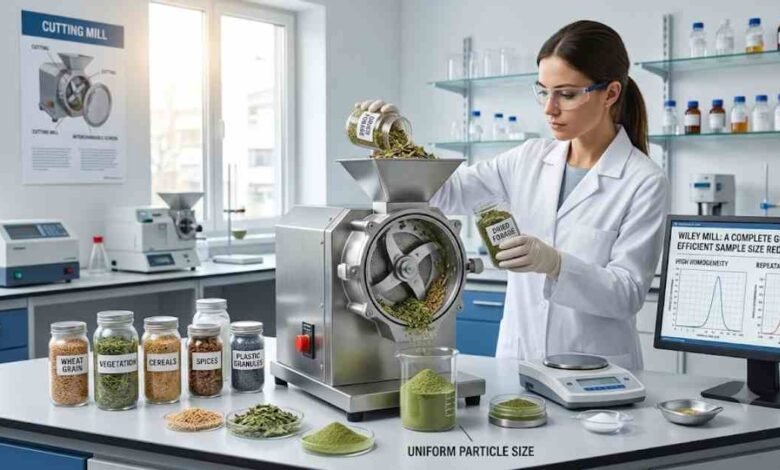
Sample preparation plays a vital role in laboratories, research facilities, and quality control environments. Among the many tools designed for this purpose, the wiley mill stands out for its ability to reduce the size of dry materials quickly and consistently. Whether preparing plant tissues, grains, plastics, or other fibrous samples, a wiley mill helps create uniform particle sizes that improve testing accuracy and repeatability.
From research applications to routine laboratory work, understanding how a wiley mill functions can help users choose the right equipment and achieve dependable analytical results.
What Is a Wiley Mill?
A wiley mill is a laboratory grinding instrument specifically designed to reduce dry samples into smaller, uniform particles. It uses rotating cutting blades combined with interchangeable screens to process materials efficiently while maintaining sample integrity.
Unlike crushing methods that may damage delicate materials, a wiley mill provides controlled cutting action. This makes it suitable for handling fibrous, brittle, and moderately hard samples.
Why Uniform Particle Size Matters
Obtaining consistent particle size is one of the most important steps before laboratory analysis. Uneven samples can produce inconsistent results, affecting the reliability of testing.
A wiley mill helps eliminate this issue by producing particles of similar dimensions, improving sample homogeneity and ensuring better analytical accuracy.
Benefits of Uniform Grinding
- Improved repeatability of laboratory tests
- Better extraction efficiency
- Faster sample preparation
- Reduced testing errors
- Consistent analytical performance
These advantages explain why many laboratories continue to rely on a wiley mill for routine sample preparation.
Common Applications of a Wiley Mill
The versatility of a wiley mill allows it to process a wide variety of dry materials.
Agricultural Research
Scientists frequently use a wiley mill to grind seeds, grains, forage, straw, and crop samples before conducting nutritional or chemical analysis.
Environmental Testing
Leaves, roots, dried vegetation, and soil-related materials often require particle size reduction before laboratory evaluation. A wiley mill simplifies this preparation process.
Food Analysis
Dry food ingredients, cereals, spices, and similar materials are commonly processed using a wiley mill to create representative laboratory samples.
Educational Laboratories
Universities and research institutions often include a wiley mill in teaching laboratories because it demonstrates efficient sample preparation while producing consistent results.
Key Features to Consider
Choosing the right wiley mill depends on laboratory workload and sample type.
Durable Construction
High-quality materials ensure the wiley mill withstands continuous laboratory use while maintaining cutting efficiency.
Interchangeable Screens
Different screen sizes allow operators to achieve the desired particle size for specific analytical procedures.
Efficient Cutting Blades
Sharp blades help the wiley mill process fibrous materials without excessive heat generation.
Easy Cleaning
Simple disassembly reduces cleaning time and minimizes cross-contamination between different samples.
Reliable Operation
A dependable wiley mill should deliver consistent grinding performance across repeated testing cycles.
Advantages of Using a Wiley Mill
Many laboratories prefer a wiley mill because it combines efficiency with precision.
Some of its major advantages include:
- Uniform particle size
- Quick sample processing
- Minimal sample loss
- Reduced operator effort
- Consistent analytical preparation
- Suitable for numerous dry materials
- Easy maintenance
These features improve laboratory productivity while maintaining high-quality sample preparation.
Tips for Better Performance
Proper operation extends the lifespan of a wiley mill and ensures reliable performance.
Select the Correct Screen
Different applications require different particle sizes. Choosing the appropriate screen helps the wiley mill produce the desired output.
Avoid Overloading
Feeding excessive material into the wiley mill may reduce grinding efficiency and place unnecessary stress on internal components.
Keep Blades Sharp
Sharp cutting blades improve grinding quality and reduce processing time.
Clean After Every Use
Routine cleaning prevents residue buildup and helps maintain consistent analytical results.
Maintenance Best Practices
Regular maintenance keeps a wiley mill operating efficiently for years.
Recommended maintenance includes:
- Inspecting cutting blades
- Cleaning grinding chambers
- Checking screen condition
- Tightening loose components
- Removing accumulated debris
- Following operating guidelines
Routine inspection minimizes downtime while maintaining reliable grinding performance.
Choosing the Right Wiley Mill
Laboratories should evaluate several factors before selecting a wiley mill.
Important considerations include:
Sample Type
Fibrous materials require different cutting performance than brittle samples.
Throughput Requirements
Large laboratories may require higher-capacity equipment than facilities handling occasional sample preparation.
Particle Size Requirements
The available screen sizes determine the final particle dimensions produced by the wiley mill.
Ease of Maintenance
Equipment designed for simple cleaning and maintenance supports efficient laboratory workflows.
Conclusion
Reliable sample preparation is the foundation of accurate laboratory analysis, and the wiley mill continues to be one of the most trusted tools for reducing dry materials into consistent particle sizes. Its efficient cutting mechanism, flexible applications, and dependable performance make it valuable for agricultural research, food analysis, environmental testing, and educational laboratories alike.
When selected, operated, and maintained correctly, a wiley mill delivers repeatable grinding results that improve analytical accuracy while supporting smooth laboratory operations. Investing in the right wiley mill ensures efficient sample preparation, consistent testing outcomes, and long-term laboratory productivity.
Read this too: Jessica Stellina Morrison: The Untold Truth of the Powerful Force Behind Gino D’Acampo’s Empire